

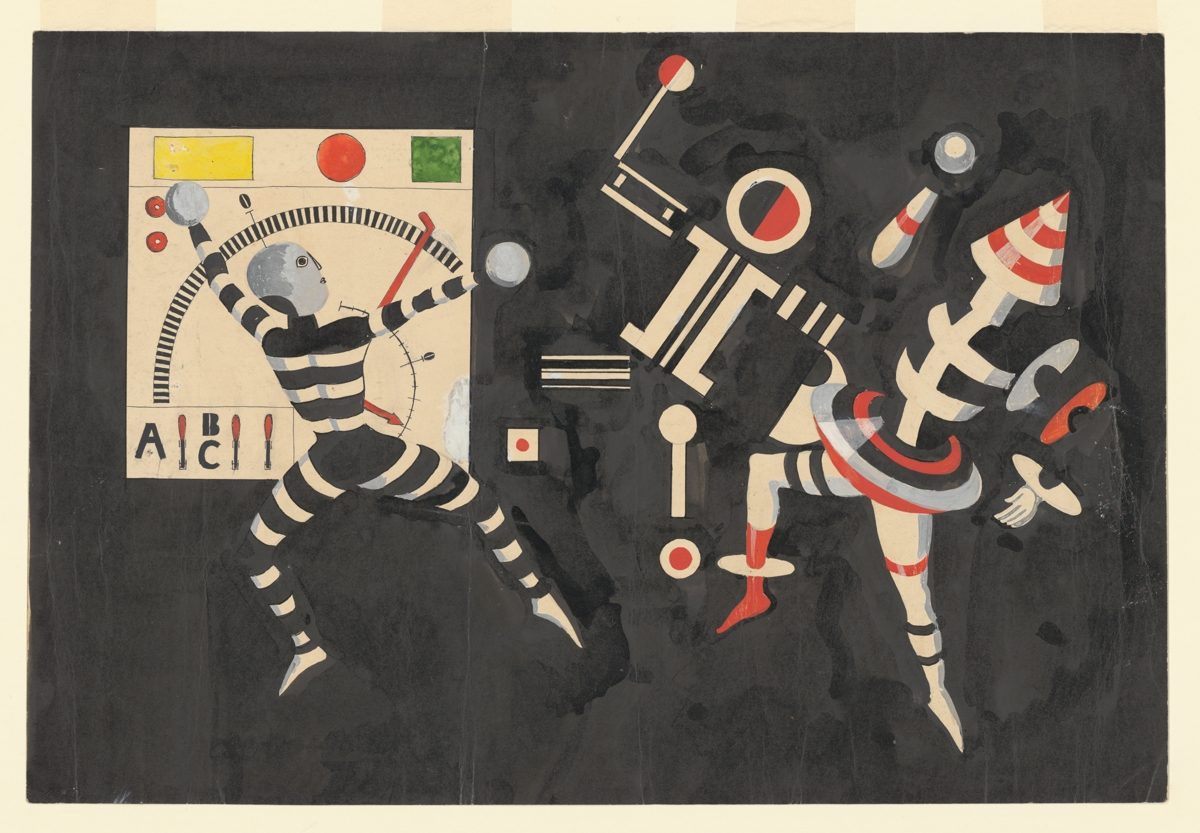
Auf schwarzem Grund steht links eine Figur in eng anliegendem schwarz-weiß gestreiften Ganzkörperanzug in dynamischer Pose vor einer hellen Schalttafel mit gelben, roten und grünen Lichtern, Tasten und einer Anzeige. Die Figur schaut nach rechts zu zwei weiteren Figuren aus schwarz-weiß-roten geometrischen Formen, sie tanzen synchron.
In the stage workshop at the Bauhaus Weimar, a group of students led by Kurt Schmidt began exploring the theme of the “mechanical stage” and the relationship between people and machines in 1922. This also led to the creation of Kurt Schmidt’s play “Der Mann am Schaltbrett” (The man at the control panel). He himself described it as a ballet dedicated to electricity, intended to express the character of the technological age. In the half-hour play, Bauhaus member George René Halkett, was the “demon” at the control panel, who controlled the movements of the other costumed performers until the machine finally took on a life of its own and seized control. Its musical accompaniment was played on various home-made instruments and was surely loud. Anyone excited about the performance could take home a picture postcard of the play as a souvenir.