
Deciphering Jak R. Maier’s Voice – By Maximilian Wahlich
While efforts to assess the estate of Jak R. Maier continue, Maximilian Wahlich, research associate and curatorial member of the project team, deciphers the secrets of Maier’s distinctive voice.
-
In 2013 the Bauhaus-Archiv received a delivery of 17 moving boxes and ten portfolios bound in ribbon. Inside were countless papers, some of which were already yellowing at the edges, numerous photos which were obviously much-used and well-loved, and sharp-angled metal figurines wrapped in tattered bubble paper. In total, the collection comprised thousands of photos, hundreds of graphic works, dozens of small models, ring binders filled with photo negatives and folders of correspondence.
-
The museum inherited these items from the Berlin couple Marianne and Jak R. Maier. The estate inventory reveals the full scope of what had originally belonged to the estate: a house in Berlin-Reinickendorf, a property in Tailfingen (Jak R. Maier’s birthplace), a VW Golf, a Porsche. The pieces of real estate, items of value and household goods were all auctioned off. After deducting the administrative and clearance fees tied to the properties, the proceeds were transferred to the “Jakob and Marianne Maier Foundation for the Cultivation of the Ideas of the Bauhaus”.
With the sale, the nature of the estate changed; the items and properties became a stack of DIN A4 pages. A lifeless list of items which had once comprised two lives.
-
We have only little information about the couple. Jak R. Maier moved from Baden-Württemberg to Berlin in the late 1950s where he taught at the University of the Arts (UdK) for 25 years and participated in several smaller exhibitions. He died in 2010, three years before his wife Marianne Maier had made arrangements for the estate. According to her testament, she wanted to leave their joint possessions to the Bauhaus-Archiv. Compared with this sparse information, however, there is a mass of private material full of redundancy.
-
Maier’s voice
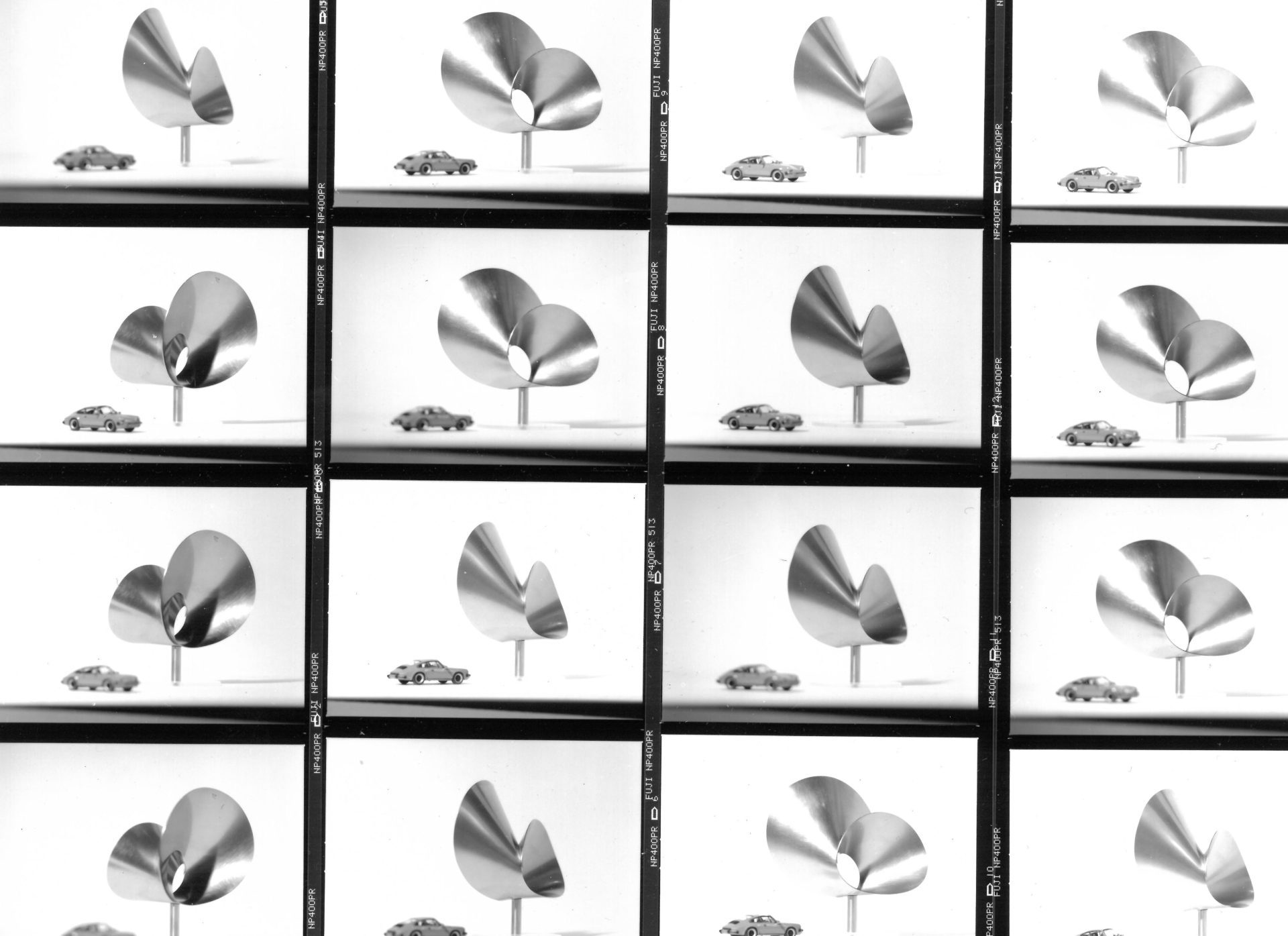
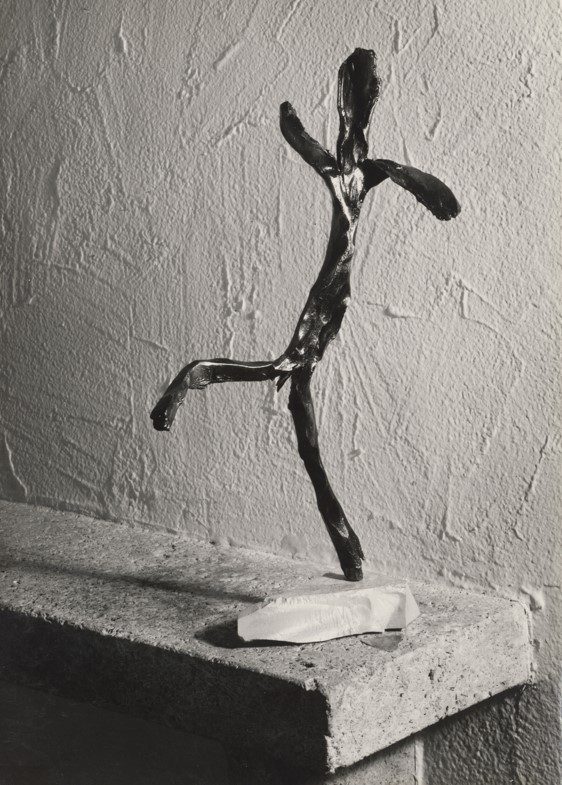
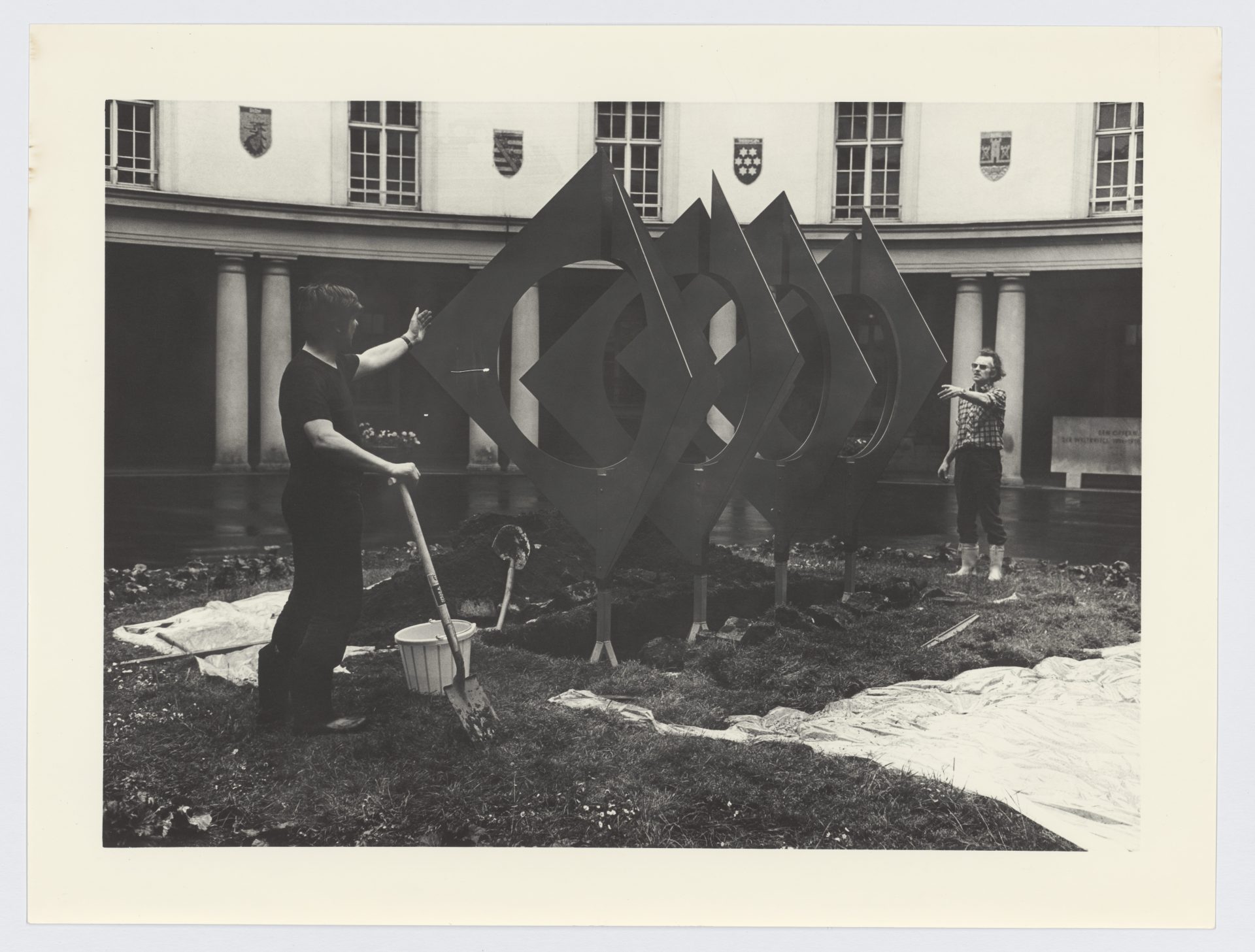
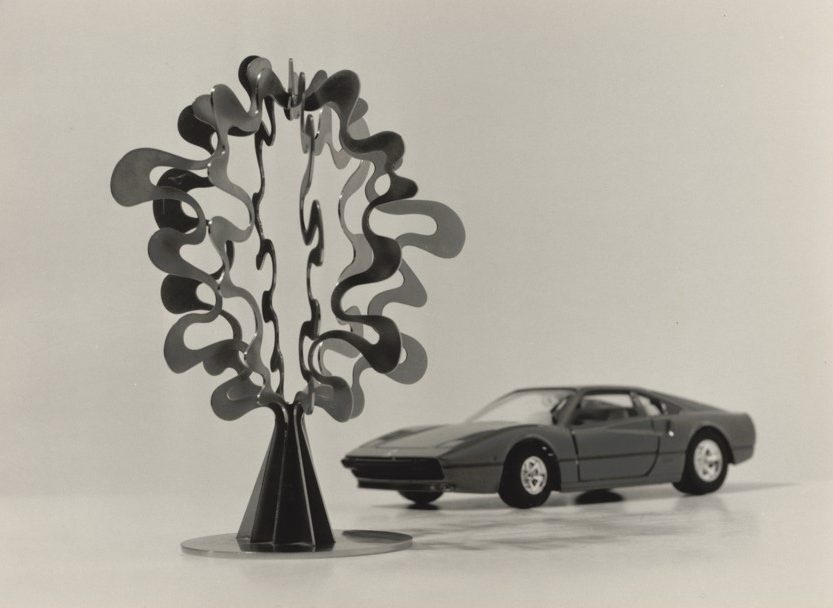
The moving boxes and portfolios now in the possession of the Bauhaus-Archiv are hardly even noted in the inheritance minutes. In fact, Maier’s entire artistic work is assigned a symbolic commemorative value of one euro. But these are the things – these objects, photos, graphic works and a handful of letters – which allow us to draw conclusions about the couple’s life. In the photos, we recognise sculptures and places, we discover Maier’s passion for sports cars, his penchant for animals and flowers, and realise that he always used the same models for his portraits. We assume there is a connection between Maier’s sleek car and exhibitions at the Porsche dealership on Kurfürstendamm in Berlin. A metal, coral-shaped sculpture is as red as the poppies in the photo next to it. A photo album shows Maier’s early works including a sculpture that looks like a giraffe – or perhaps it was an animal of his imagination?
-
Over time we recognise that the estate is riddled with repetition. We are presented with a complex grammar of duplicates that lend structure to over 4,000 pages, snapshots, sheets of graphic art and objects. We find the same motif in multiple forms – as a single contact print buried beneath a pile of many others, then again neatly stapled to a registry, then enlarged and finally on one of a thousand negative strips.
-
Maier also used various forms of presentation. While he staged an object as an autonomous work in one photo, he placed the same object in another as a model for spatial reference, thus highlighting the dimensions between, for example, a fictitious car or a female figure.
Speaking with Maier
In our project, we discuss Jak R. Maier’s personal items and artworks. We archive, deposit and preserve his estate for future research endeavours. We support Maier’s meticulous self-archiving method by reproducing photos of his works, updating information and documenting what we have learned about him. And throughout the process, we annotate and examine the estate with a critical eye. What did Maier’s reality look like, living among the creations of his own life? With each document, we learn to decipher these clues better. The exhibition is not the final chapter of Jak R. Maier’s life, but rather a stepping-stone and invitation to study his legacy further. A process with an open end.